
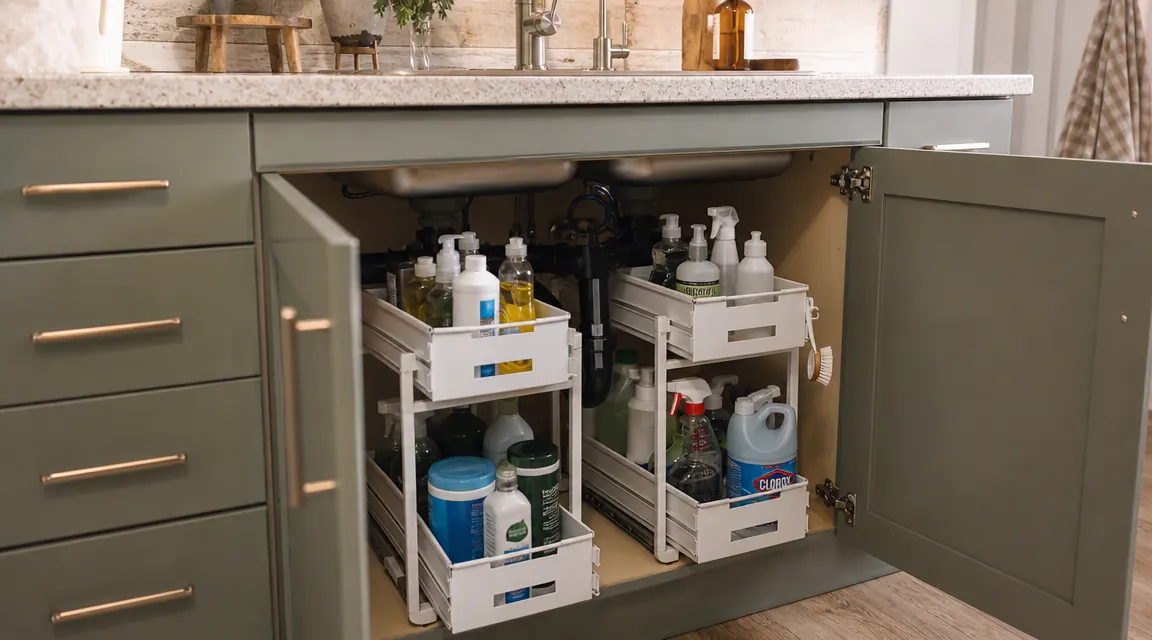
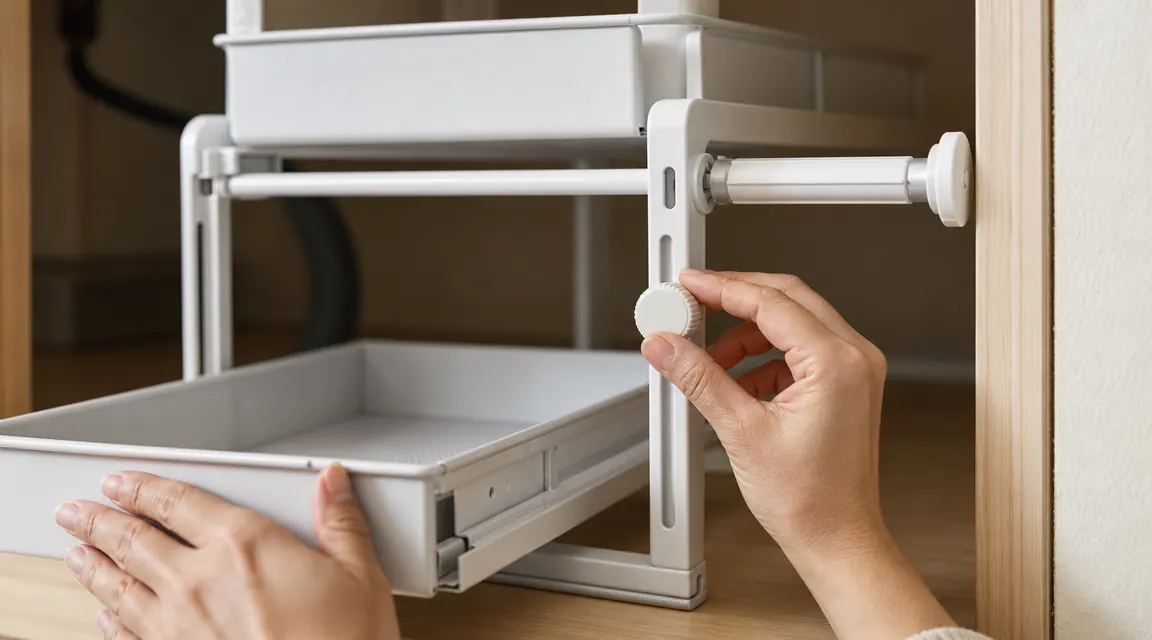
About three weeks after buying the PXRACK two-pack, I got a message from my sister-in-law saying she had bought the same organizer based on my recommendation and could not figure out how the feet worked. She thought the round knobs were supposed to stick to the cabinet floor like suction cups, and when they would not stay down she figured the unit was defective. They are not suction cups. They are tension feet. You twist them outward until the rubber pads press against the inside walls of the cabinet, and that friction is what holds the unit in place. Nothing sticks to anything. The listing description is a little vague on this, and it is the single most common assembly question I see in the product Q&A. I want to start there because if you understand how the feet actually work, everything else about this organizer makes sense.
The PXRACK (ASIN B0D176VGXZ) is a two-pack of two-tier pull-out under-sink organizers made from powder-coated steel. Each unit has an adjustable upper shelf and a lower tray that slides out on a center rail. It is renter-safe because it requires no drilling, no adhesive, and no modifications to the cabinet. The price for the two-pack is in the mid-forty-dollar range at current pricing. At 4.7 stars across nearly 1,800 reviews, it has a strong rating. But the reviews tend to cluster around the same talking points, and there are a few things that matter a lot to the buying decision that almost nobody covers.
The Quick Verdict
A genuinely useful organizer for standard bathroom and kitchen sink cabinets, with a few fit gotchas that the product page underplays.
Amazon Check Today's Price →If you have been reaching blind into the back of your sink cabinet for months, the pull-out design solves that specific problem.
The PXRACK two-pack brings the entire cabinet contents forward to you every time you open it. Check today's price and availability on Amazon before you decide.
Amazon Check Today's Price on Amazon →How the Tension Feet Actually Work (and Why Half the Reviews Skip This)
Each unit has four adjustable feet, one at each corner of the bottom frame. They are round knobs on threaded posts. You turn the knob clockwise to extend the post outward, which pushes a small rubber pad against the interior wall of the cabinet. The goal is to create four-point lateral tension, not downward suction. When you have the tension set right, the unit does not move when you pull the slide tray open or when you reach into the back of the upper shelf. When the tension is too loose, the whole frame will creep forward as you pull the slide. This is the problem my sister-in-law ran into, and it is the problem most of the one-star reviews describe.
The correct installation sequence: set the unit in position first, then extend the outer feet until you feel resistance against the cabinet walls, then do a test pull on the lower tray. If the frame stays put, you are done. If it moves even slightly, extend the feet another quarter turn. You should not need to use significant force to turn them. If you are forcing the feet, you have gone past the right point and the rubber pad might not be seated flat anymore. The whole adjustment takes about two minutes once you have done it once. It is not complicated, but it is also not intuitive if you are expecting a suction mechanism.
The Width Math That the Product Page Gets Wrong
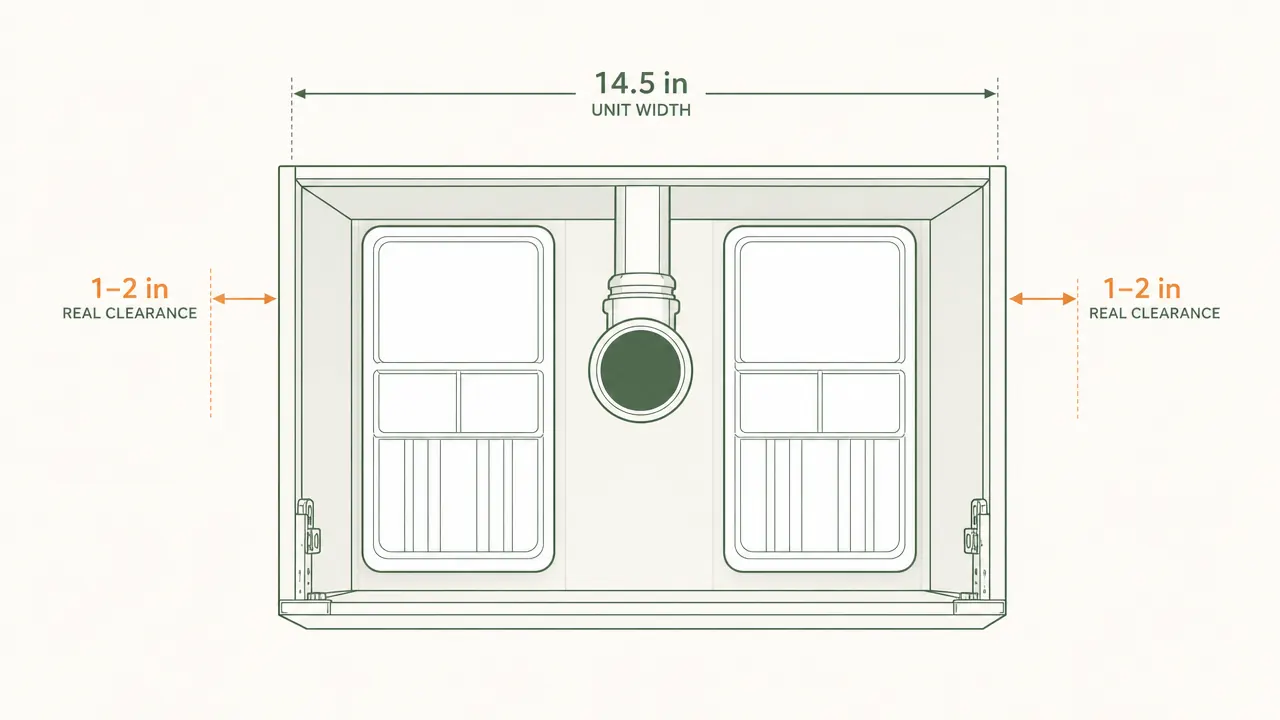
The listing says each unit is 14.5 inches wide. That is true for the outer frame measurement. What the listing does not tell you is that you need roughly an inch of clearance on each side between the outer frame and the cabinet wall for the tension feet to have something to press against. So the real usable footprint per unit is closer to 16.5 inches of interior cabinet width. Two units side by side need about 33 inches of interior cabinet width total, assuming the P-trap pipe runs straight down the center and you are placing one unit on each side of it.
Most standard bathroom vanity base cabinets in the 36-inch range (common in American apartments and houses built after 1990) have an interior width of about 34 to 36 inches, which is enough. The problem comes up with 30-inch vanities, which have an interior width closer to 28 inches, and with small-footprint pedestal-style vanity cabinets under 24 inches wide. I measured three different bathroom cabinets at houses in my neighborhood, and two of the three 30-inch vanities came in at 27.5 inches interior. That is tight for two units and essentially impossible if you also have a thick supply line running vertically near one of the side walls. Measure your interior width before you buy, not after.
The Upper Shelf Tip Problem: What Nobody Explains in Five-Star Reviews
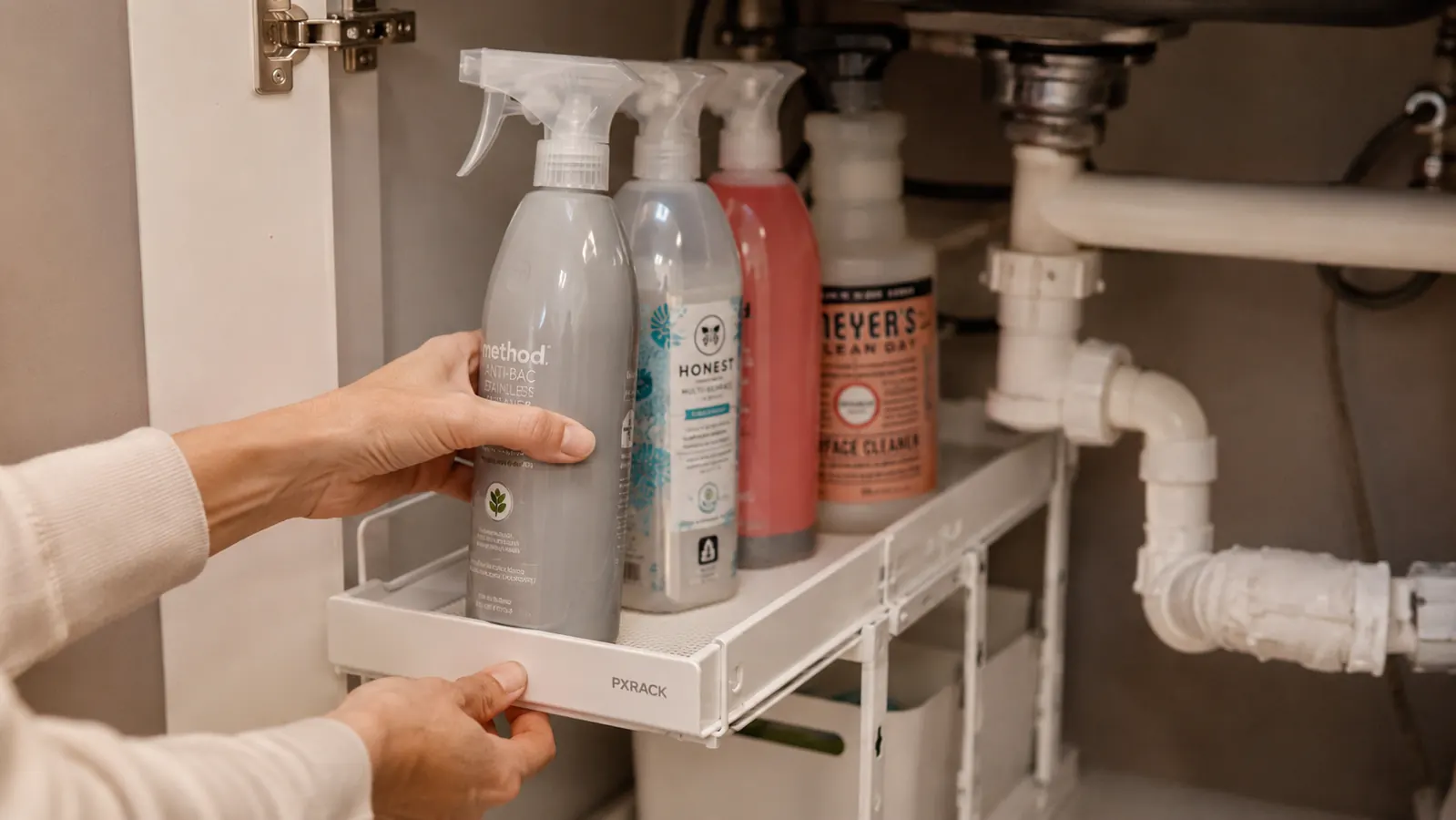
The upper shelf has a raised lip on the back and the two sides, but not on the front. The open front makes it easy to slide tall bottles in and out, which is genuinely useful. It also means that if you close the lower tray quickly or bump the cabinet door against the frame, a tall thin bottle near the front edge of the shelf can tip forward and fall. I knocked a bottle of bathroom spray cleaner off the front edge the third day I had the organizer. It was not a disaster, but it startled me enough that I paid attention to how I was loading the shelf after that.
The fix is simple: arrange taller, thinner items toward the back of the upper shelf and shorter, wider items toward the front. A can of scrubbing powder, which is squat and stable, is fine at the front edge. A 24-ounce bottle of spray cleaner with a narrow base needs to go near the back wall where it has something to lean against. Once I adopted that arrangement it stopped being an issue entirely, but I wished someone had said it plainly before I bought rather than after. The five-star reviews tend to describe the shelf as generous and easy to load, which is true, but they skip the tip dynamic entirely.
The open front lip is the same feature that makes the shelf easy to load and the feature that sends a spray bottle to the cabinet floor if you are not paying attention to where you put the tall stuff.
How the 30-Pound Rating Translates to Real Cleaning Supplies
The product page rates each unit at 30 pounds. That number is higher than what most people actually store under a sink. A full 28-ounce bottle of cleaning spray is roughly 2 pounds. A full 64-ounce bottle of dish soap is roughly 5 pounds. A spare roll of paper towels is under a pound. Unless you are storing a complete backup supply of every cleaning product you own plus a few gallons of bleach, you are nowhere near 30 pounds per unit. The rating is not really the limiting factor.
What matters more in practice is height and diameter of the items you are storing on the lower tray versus the clearance left under the upper shelf. At the lowest height setting on the upper shelf (6 inches clearance), you can fit items that are 5 inches or shorter on the lower tray and still pull the tray out without catching on the upper shelf bracket. At the highest setting (9.5 inches), you have room for a standard 32-ounce spray bottle standing upright on the lower tray, which gives you a lot of flexibility. Most people will want the upper shelf at the third or fourth position to clear a typical P-trap and still have useful space on the lower tray.
What the Slide Feels Like After the First Month
The lower tray slides on a single center rail. When you first assemble the unit and set the tension feet, the slide has a slight resistance at the start of the pull, then glides smoothly once it breaks free of the initial stiction. That stiction gets lighter after the first week of daily use, similar to how a new drawer runner loosens up. After about a month, the tray pulls and pushes with a consistent, low-friction feel. There is no ball-bearing mechanism, just metal on metal with a light factory lubricant. If you ever feel gritty resistance after extended use, a small amount of silicone spray on the rail is all it needs.
One thing the reviews almost never mention: if you load the lower tray unevenly, with most of the weight on one side, the tray will drag slightly on the side with more load. This is not a defect. It is physics. Center your heavy items or distribute weight roughly evenly and the slide stays straight. I loaded mine asymmetrically for about a week before I noticed the drag, redistributed the bottles, and the issue went away. It is worth mentioning because a few one-star reviews describe this drag as a defect when it is really a loading error.
Renter Move-Out: Does It Leave Marks?
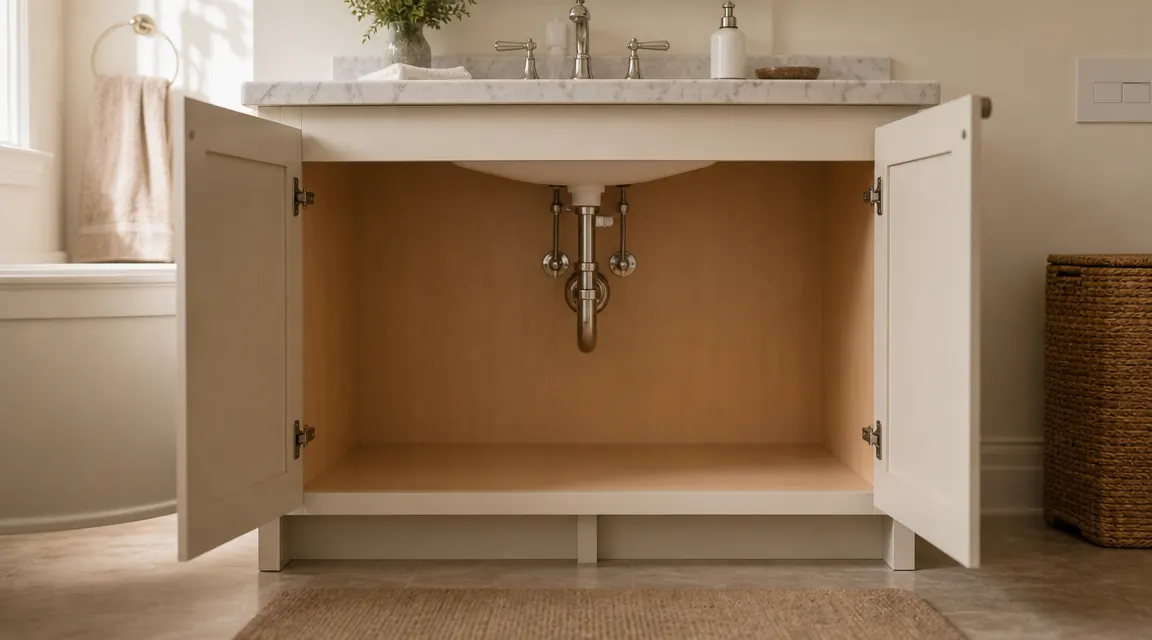
This question matters a lot to renters and it almost never comes up in reviews. The tension feet leave small depressions in some cabinet surfaces if the unit sits for more than a few months, particularly in lower-end melamine-lined cabinets where the surface is softer. In my bathroom cabinet, which had a standard melamine white interior, I could see faint round marks from the rubber pads after removing the unit. They were about the size of a pencil eraser. I wiped the area with a damp cloth and they lightened significantly. They were not the kind of damage that would cause a landlord to withhold a deposit, but they existed.
If you want to avoid this entirely, put a thin piece of shelf liner paper under the rubber pads. Cut four one-inch squares, stick them under each foot position, and the rubber presses into the liner instead of the cabinet floor. The unit still holds because the tension mechanism works laterally, not through downward compression. It takes three minutes and costs nothing if you already have a roll of shelf liner, which most renters do.
The Situations Where This Organizer Does Not Work
The most common mismatch I see is people buying this for a cabinet that is too shallow to let the lower tray fully extend. The tray needs about 17 inches of cabinet depth from front to back to reach full extension. If your cabinet is shallower than that, the tray stops before it is fully out, which means items near the back of the tray stay partially out of reach. For a cabinet that is exactly 15 inches deep, the tray can only come out about 10 inches, which is still better than a static shelf but not the full advantage the product is designed to provide. Measure depth as well as width.
The second mismatch is people expecting this to work in kitchen sink cabinets where the drawer bank sits directly above the sink base on one side, creating a half-height cavity. In those cases the cabinet interior height is often only 9 or 10 inches on the drawer side, and the PXRACK two-tier design needs at least 12 inches of clear interior height to install and use both tiers. In a half-height cavity you can use the lower tray alone if you remove the upper shelf entirely, but at that point you are paying for a two-tier organizer and getting one tier. For that situation, a purpose-built single-tier slide organizer is a better fit.
What I Liked
- Renter-safe tension feet require no drilling, adhesive, or permanent modifications
- Five height positions let you dial in exact clearance for your specific plumbing layout
- Lower tray extension brings cabinet contents fully forward, eliminating blind-reach storage
- Steel frame with powder-coat finish wipes clean easily and does not rust under normal kitchen or bathroom humidity
- Two-pack gives you symmetrical organization on both sides of a center P-trap
- Tension foot adjustment takes about two minutes per unit and holds firmly once set
Where It Falls Short
- Upper shelf has no front lip, so tall thin bottles need to be arranged deliberately to avoid tipping
- Tension feet can leave faint impressions on softer melamine cabinet floors after extended use
- Each unit needs at least 16.5 inches of interior width including foot clearance, not just the 14.5-inch frame measurement
- Lower tray requires 17 inches of cabinet depth for full extension, shallower cabinets get partial benefit only
- Asymmetric loading on the lower tray causes slight drag on the slide rail until weight is redistributed
- Not suitable for half-height kitchen sink cavities where interior height is under 12 inches
Who This Is For
Buy the PXRACK two-pack if you have a standard 36-inch or wider bathroom or kitchen sink base cabinet with a center P-trap and you want to use both sides of the pipe. The product works best when the interior height is at least 12 inches, the interior width is at least 33 inches, and the depth is at least 17 inches. If those three measurements check out, this organizer will do what it promises. If you have not measured all three and you are buying based on photos alone, there is a meaningful chance of a mismatch. For a full step-by-step measuring guide and installation walkthrough, see my under-bathroom-sink organization guide that covers exactly how to take the right measurements before you order.
Who Should Skip It
If your bathroom cabinet is a 30-inch or smaller vanity with a narrow interior, one unit will likely fit but two will not, and the two-pack value proposition disappears. If your kitchen sink has a half-height cavity on one side because of a drawer bank, the two-tier design will not fit that side. And if you are in a rental where your cabinet floor is very soft material and you are concerned about any surface impression at all, either use the shelf liner trick mentioned above or consider a static shelf alternative that sits on flat feet rather than tension feet. For a detailed comparison of this organizer against a static shelf option, the pull-out vs static shelf comparison covers the full tradeoff in one place.
If your cabinet dimensions check out, this is the organizer that actually solves the reach-and-guess problem under the sink.
The PXRACK two-pack is the clearest fix for a center-plumbing bathroom or kitchen cabinet where a static shelf just pushes things further out of reach. Check today's price on Amazon before you finalize.
Amazon Check Today's Price on Amazon →